
ENGINEERING DOCUMENT INTELLIGENCE · PRIVATE DEPLOYMENT · CUSTOM AI WORKFLOWS
IRISX / AI Acceleration
AI ACCELERATION

AI runs on data.
Engineering AI needs context.

Give RAG systems, technical copilots, search applications and AI agents better-prepared engineering information—not just disconnected text extracted from PDFs.

ENGINEERING AI · WORKFLOW CONCEPTIllustrative
Which drawing characteristics changed in Revision B?
AI-ready data view · concept

Structured revision information could link changed characteristics to drawing locations and reviewer evidence.

Illustrative source: Drawing Rev B → characteristics → change record
THE PROBLEM

An LLM cannot recover context it never received.

Generic document ingestion may recognize words while losing associations between technical objects, tables, diagrams, revisions and source evidence.

COMMON BASELINE

Raw PDFs → text chunks → RAG

  • Callouts separated from the right features.
  • Tables split into meaningless lines.
  • Revision context lost during indexing.
  • Technical relationships left implicit.
  • Answers difficult to trace or verify.
These are common risk scenarios, not claims that every generic parser fails.
IRISX-ENHANCED APPROACH

Technical content → contextual data → AI

  • Capture relevant technical elements.
  • Preserve document structure where supported.
  • Attach document, page and revision context.
  • Represent selected relationships.
  • Support source-linked, reviewable AI workflows.
Target architecture; each integration must be implemented and evaluated.
THE INTELLIGENCE LAYER

From technical records to AI-ready knowledge.

IrisX is the preparation layer—not a claim to replace the customer’s LLM, vector database, PLM or enterprise search product.

INPUT
Engineering documentsDrawings · specifications · scans
→
IRISX
Technical content intelligenceExtract · review · structure
→
OUTPUT
Structured technical recordsFields · metadata · source links
→
INTEGRATE
RAG / AI agents / analyticsCustomer-specific connectors
POTENTIAL OUTCOMES

The data-layer advantage for enterprise AI.

Benefits to validate during a proof of concept—not guaranteed performance claims.

Improved retrieval relevance

More meaningful document chunks and technical fields can improve what the AI system retrieves.

Clearer answer evidence

Source references and characteristic relationships can help users assess an AI response.

Less one-off preparation

Reusable technical records can reduce repeated document cleanup for future applications.

More practical AI agents

Agents can work with organized records rather than re-reading long technical PDFs for every action.

Faster application prototyping

Structured inputs can speed integration experiments and custom workflow development.

Sensitive-data control

Private processing can be paired with approved local AI infrastructure where implemented.

EXAMPLE CUSTOM PROJECT

Trace a requirement through engineering decisions.

Imagine an AI assistant asked which inspection records could be affected by a change to a pressure specification.

  1. Find the pressure requirementExtract the relevant clause from a source specification.
  2. Identify linked technical recordsConnect references to drawings, characteristics, and inspection documents.
  3. Generate a reviewable assessmentSummarize possible impacts with links to supporting source evidence.
  4. Engineer approvesUse human validation for safety- and quality-critical decisions.

Custom solution concept — not a shipped assistant

ILLUSTRATIVE SOURCE CHAIN
SPEC-PUMP-102 / Section 3.2

“Operating pressure: 150–200 psi”

DWG-PUMP-017 / Rev B

Associated component and reviewed characteristic

INSP-PUMP-047

Linked verification or inspection evidence

Synthetic data and links for conceptual demonstration only.
PROVE THE IMPACT

Start with a measured AI data-readiness pilot.

Rather than claim that content intelligence always improves AI accuracy, establish a baseline and evaluate improvement on representative engineering documents.

Extraction fidelity

Assess technical values and structural preservation.

Answer grounding

Measure evidence links and supported answers.

Review time

Compare effort required to validate outputs.

Processing efficiency

Track throughput, cost, and repeatability.

FROM OCR TO DOMAIN CONTEXT

A more useful foundation for RAG and engineering agents.

The source document provides the text, but the part, revision, BOM position and related decision explain what the information means. Structured connections create a richer retrieval and reasoning layer.

See the connected-context concept →
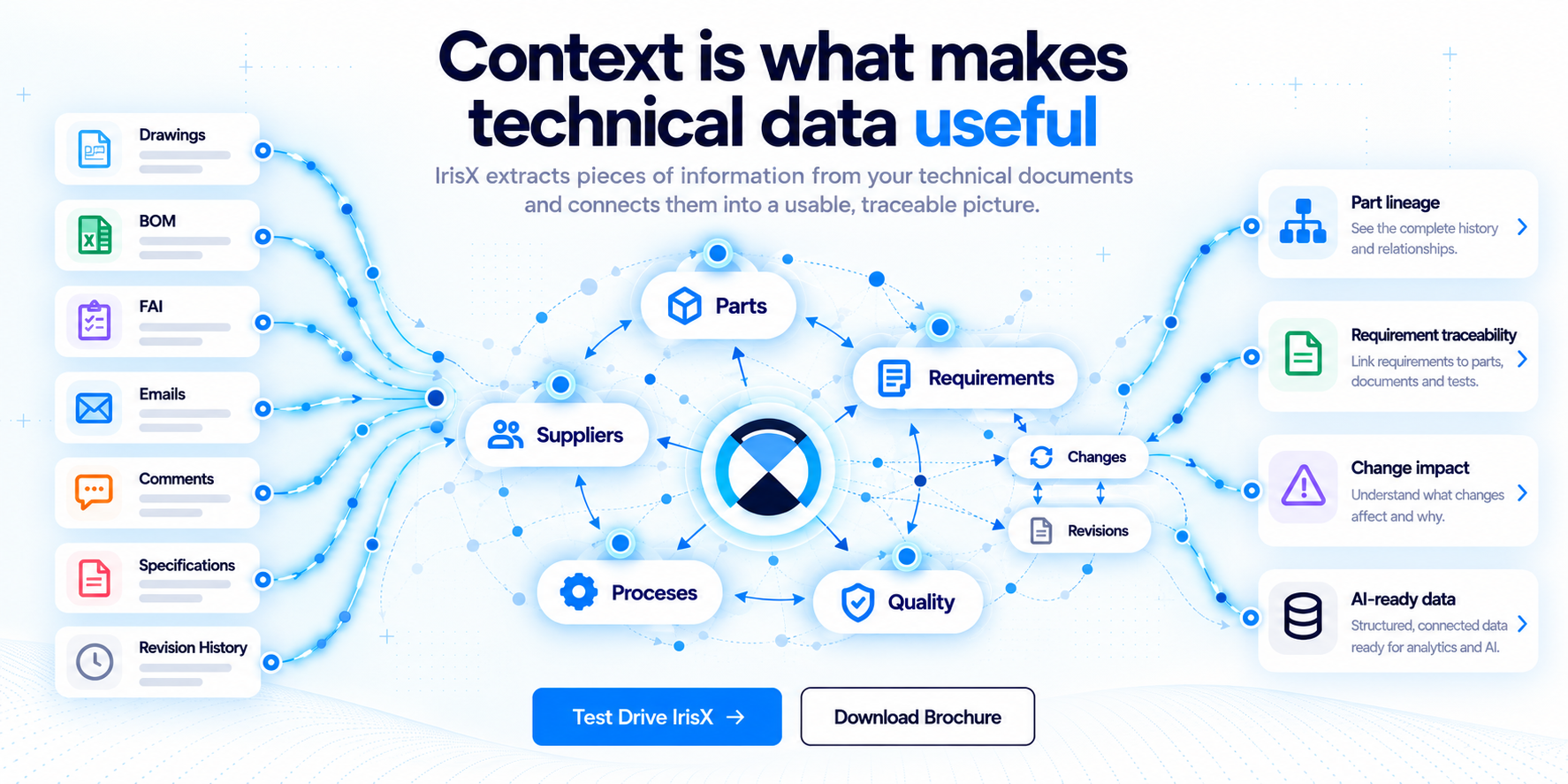
Engineering domains linked to source documents, technical history and AI-ready data

Illustrative architecture; performance benefits must be measured on real customer workflows.

START WITH YOUR DOCUMENTS

Better AI begins with better engineering data.

Bring a technical-document use case and let us define a proof-of-concept with measurable extraction and AI-readiness criteria.