
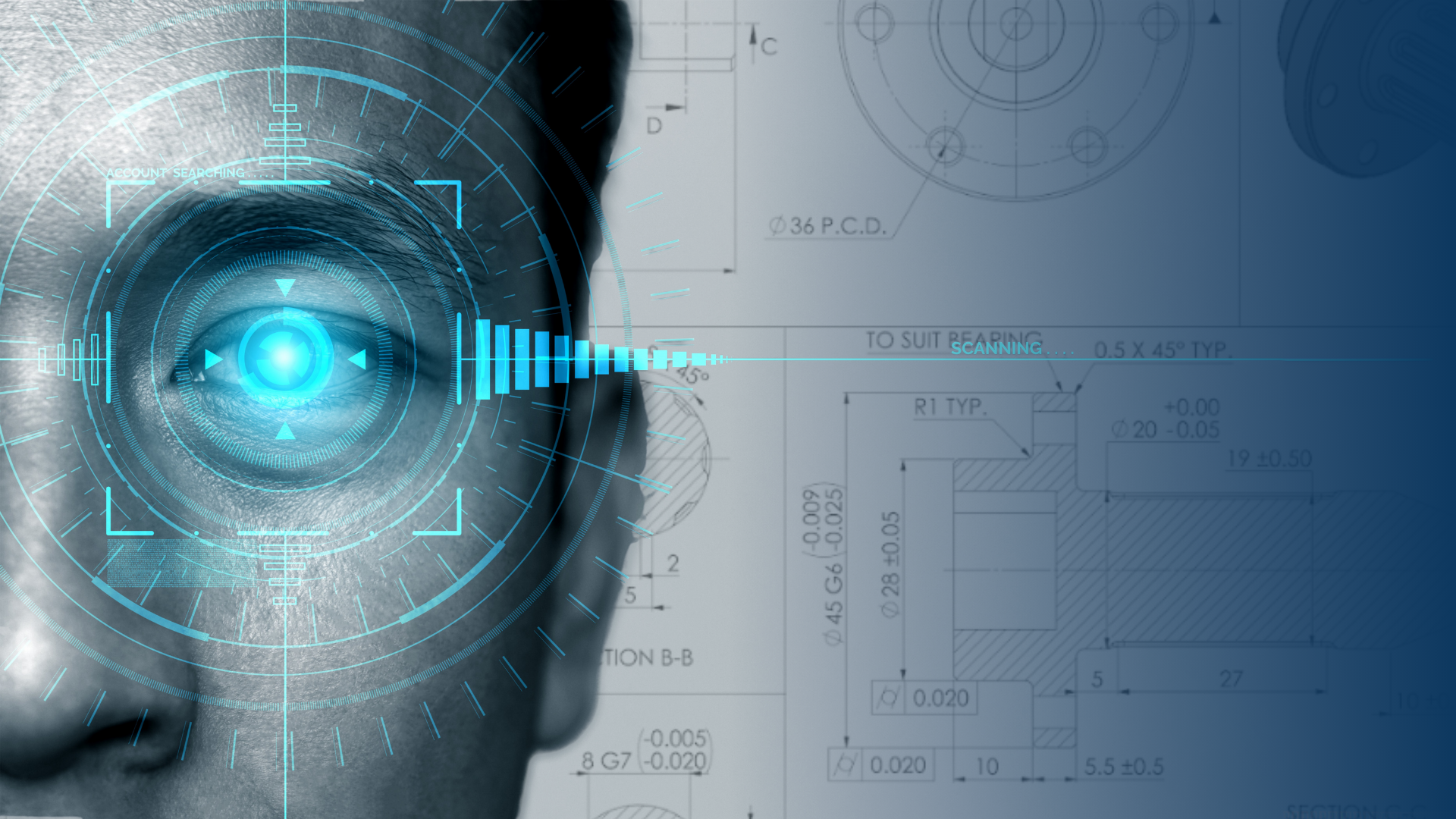
In today’s fast-paced manufacturing environment, mechanical engineers face mounting pressure to deliver precision while reducing time to market. One of the most tedious, error-prone tasks is pulling dimensional data from technical drawings. Enter IrisX – a purpose-built computer vision platform for mechanical and quality engineers that transforms how professionals extract measurements and GD&T directly from CAD and hand-drawn drawings.
The Hidden Cost of Manual Data Extraction
For decades, mechanical engineers have painstakingly reviewed technical drawings, manually extracting critical dimensions, tolerances, and annotations.
This process is:
- Time-consuming: Engineers often spend 20-30% of project time just interpreting and transferring drawing data
- Error-prone: Studies show manual transcription has an average error rate of 1-3%, potentially leading to costly manufacturing mistakes
- Monotonous: Skilled engineers waste valuable time on repetitive tasks instead of value-added design and problem-solving
The financial implications are substantial. A single misread dimension can result in scrapped parts, production delays, and even product failures. In high-precision industries like aerospace or medical device manufacturing, these errors can have particularly severe consequences.
Why Traditional OCR Falls Short
Generic OCR tools were designed for typed text in documents, not the rich symbology of engineering drawings. They struggle with:
- GD&T symbols and feature control frames
- Mixed content of text, numbers, sketches, and graphics
- Diverse formats ranging from legacy blueprints to modern CAD exports
The IrisX Advantage: AI-Powered Computer Vision
IrisX goes beyond character recognition. It’s been engineered from the ground up to understand mechanical engineering notation and context:
Full GD&T Interpretation
IrisX recognizes datum references, feature control frames, and tolerance values, delivering structured data that preserves relationships between features.
Contextual Measurement Understanding
By analyzing symbol position and geometry, IrisX distinguishes diameters, depths, linear dimensions, and more—so you get semantically accurate data, not just numbers.
Seamless CAD Integration
Extracted data flows directly into your CAD environment to verify existing models or auto-generate parametric dimensions.
Revision Comparison
Automatic diffing between drawing versions highlights dimensional changes, so you never miss a critical update.
Real-World Impact: Engineering Efficiency Transformed
The benefits of implementing specialized OCR for engineering drawings extend throughout the product development cycle:
Design Verification
Engineers can automatically compare as-designed specifications against as-built measurements, instantly identifying out-of-tolerance conditions without manual data entry.
Quality Assurance
QA teams can rapidly process inspection reports by automatically extracting acceptance criteria from technical drawings, ensuring consistent interpretation of requirements.
Manufacturing Setup
CNC programmers and manufacturing engineers can extract critical dimensions without transcription errors, reducing setup time and improving first-pass yield.
Legacy Drawing Management
Organizations with extensive archives of older drawings can digitize this intellectual property into structured data, preserving engineering knowledge while enabling modern digital processes.
Getting Started with AI-Driven Data Extraction
To take advantage of this technology, take these steps:
- Audit your current process: Document how much time your team currently spends on manual data extraction
- Identify error-prone areas: Review where transcription mistakes have caused issues in the past
- Consider your drawing ecosystem: Take inventory of your drawing formats (paper, PDF, native CAD)
- Start with a pilot project: Test the technology on a representative sample of your drawings
The Future of Engineering Data Capture
As manufacturing embraces the digital thread, computer vision will not only extract data but also flag potential design or manufacturability issues based on historical patterns—evolving into a proactive AI engineering assistant.
The next evolution will likely incorporate machine learning to not only extract data but to identify potential design issues or manufacturing challenges based on historical patterns – transforming OCR from a simple data extraction tool into an AI-powered engineering assistant.
Conclusion
In an era where engineering efficiency determines competitive advantage, manual extraction of dimensional data represents an outdated bottleneck. Purpose-built computer vision solutions like IrisX are eliminating this constraint, freeing engineers to focus on innovation rather than transcription.
By automating the capture and interpretation of critical dimensional data from CAD drawings and GD&T, IrisX is helping mechanical engineering teams work faster, with greater accuracy, and with more confidence in their data integrity.
Contact us to learn how IrisX can transform your engineering workflow through automated dimensional data extraction.